The Crested Butte News Serving the Gunnison Valley since 1999


By Dawne Belloise
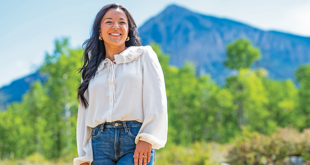
As a two-term president of the Adaptive Sports Center board, Meg Smith shares that her involvement with Adaptive is the hardest job she’s ever had. “I think it’s because I feel so strongly about our mission. It’s about being able to help people with disabilities experience the outdoors and to help them realize they can do so much and they can do it with their friends and families.”
In the morning at Adaptive, while the participants are gearing up for their day’s activities, Meg sees the changes and the benefits of the programs. “You might talk to a wounded warrior who is very nervous, because they’re not sure they can do it, even if they skied before they became disabled. They’re scared and unsure. Then you’ll see them two days later and you can see the change in their confidence and belief. It just makes you so proud to be involved in an organization that can help so many people.”
Since 2012, Meg has been attending Adaptive galas and she joined the committee of Adaptive’s Crested Butte Open, which is a well-attended fundraiser dinner and auction in early August at Lacy’s barn. Initially she was helping to create and organize the event when she was asked to join the board in 2017. She and her hubby Michael are supporters of many valley organizations. “It’s hard to attend everything but we try to support as many of the local organizations as we can.”
Meg hails from Louisiana and she says that two things truly bonded her family — tennis and Louisiana State University (LSU), especially LSU football. Her family held season tickets to LSU home games for more than 60 years, “Which makes me feel old as the stadium celebrated its 100th anniversary last year,” she laughs. She recalls fond memories of tailgating and Saturday mornings spent helping her mom fry chicken, make sandwiches and bake brownies, all to pack into the family station wagon. “The eight of us, often with a friend or two, would cram into the car for the two-hour drive to Baton Rouge.” Parking near the stadium, the family would picnic, toss the pigskin and visit with friends before heading into the game. “My parents sat near the 50-yard line while the kids were in the end zone. We could see my parents from our seats and kept an eye on them, especially if the game was going badly as my dad often decided to leave early. More than once, we heard the crowd erupt in celebration of an LSU comeback as we walked back to the car, telling ourselves it never would have happened if we’d stayed.” Meg also grew up playing competitive tennis and tournaments in the South. She was on the first women’s tennis team at LSU.
Growing up in New Orleans, she attended a small private school that was actually in a house with a teacher that she swears was about 110 years old. “She would stand at the front door at the end of the day and on our way out the girls would have to curtsey, and the boys would bow.” Later, Meg attended Louise S. McGehee, an all-girls school in New Orleans. “I loved it because you didn’t have all that boy stuff to worry about,” she smiles.
After high school, Meg attended the University of Virginia and was in the first class of undergraduate women. She was an art history major and intended to continue for a master’s in art history. Her goal at the time was to work at the National Gallery in Washington, D.C., however, she did not like the school. “The deal was that half of the men and professors didn’t want women there. They wanted nothing to do with us, but the other half of the students literally camped out in front of the dorms because they were so excited to have women there that they hung out in front to meet us.”
The University of Virginia was a big change from her small high school, and she just wasn’t happy there. “I decided to save my parents some money and go back home to LSU,” so she transferred back home to LSU and graduated with an art history degree. During the summers while she was at university, Meg worked at her father’s law firm as an office assistant. After graduation, she was hired as a librarian for a law firm in New Orleans. In the pre-computer era, firms had to have someone to do research. She was also a court runner, shuttling documents for judges to sign.
In 1975, Meg became a paralegal until one day while working for lawyers, she realized that she could be a lawyer herself. She enrolled at LSU Law School, graduated and passed the Louisiana bar. She didn’t stop there — Meg moved to Texas, passing that bar and later to Thousand Oaks, California, and passed that bar as well. In between, Meg had met Michael in Louisiana, moved to California, had two sons, Taylor and Walker, and was practicing law through it all. Her husband was a lawyer with Exxon and after three years in California, in 1989 they were transferred to Anchorage, Alaska. Meg got a part-time job with a firm there, primarily doing business law. “Every lawyer in Alaska was either suing Exxon or representing them.”
She wasn’t enjoying the work and most of her income was going to daycare. Meg decided to start a new career as a volunteer for non-profits. “It doesn’t pay monetarily but I think it pays in a lot of ways that are even better,” she says. In Alaska she was a docent at the Anchorage Museum of History and Arts and was on the board of Imaginarium, a children’s science museum. She was also a PTA mom and still playing a fair amount of tennis.
In 1996, the family relocated back to the Houston area and then when Exxon merged with Mobil, the family was uprooted again to Great Falls, Virginia, in 2000. “We loved it there, but our kids hated it.” A year and a half later, they transferred back to Houston. “I became really active in tennis-related things, on the board of the Houston Ladies Tennis Association with 4,000 women.” They belonged to the Houston Racquet Club and Meg became president of their women’s association, later taking up the mantle of the first woman president of the entire club.
On Memorial Day weekend in 2015, Meg’s family was deeply affected by the Wimberley flood. “We had purchased our Blanco River property in 2012 and built additional structures so our large family could gather there. Although the lower house sat about 40 feet above the river, the water rose with shocking speed that night.” Meg and her daughter-in-law were in the lower house when the flood hit. Within minutes, water was waist-deep. “We escaped uphill in the dark, clinging to each other. As the water kept rising, we watched our SUV lift off the ground, strike the house and disappear downstream. Ultimately, the water reached the second floor.” There were 15 of them, including a three-month-old baby and three dogs. They evacuated in three cars and eventually found shelter in Bastrop. “Most of our property was destroyed, though thankfully our insurance and FEMA helped us rebuild.”
Meg feels that traveling is an incredible way to experience culture and life around the world, and she’s done quite a bit of it: Australia, New Zealand, Greenland, Patagonia, the Straits of Magellan, Africa, Tanzania, all over Europe and last January, they visited Egypt. This April, they’ve planned an extensive tour covering eastern Europe, beginning on the Danube in Budapest then on to Romania, Transylvania and Croatia. “We have had the opportunity to travel to many places around the world, but my favorite place on earth is Anvik River Lodge in Alaska. It is the most remote fishing lodge in the state, reached by a two-hour plane ride followed by a two-hour boat trip up the Anvik River.”
They had moved to Anchorage twice. “It has an amazing art and history museum,” she says, where she was a docent. “It’s kind of like Crested Butte where in winter the non-profit organizations put on their galas and main fundraiser. We get a lot of tourists in the summer and the sun doesn’t set and that’s when they all come in.” She adds that there’s also night skiing at Alyeska, about an hour away.
Anchorage is where Meg fell in love with the mountains and decided she needed mountain views to break up the flatness of her Texas view scape. A friend had told them about Crested Butte and they visited in the summer of 1997. She says it felt like coming home.
When Meg and Michael aren’t in Crested Butte from May through October, they spend the other half of their lives in Wimberley. Meg returns to CB for meetings in March and December as well. “We know more people and are more involved in the CB community than we are in Wimberley. I would be in Crested Butte all year long, but we have 10 grandkids, all in Texas.”
So for now, Meg says she’s happy splitting her time while helping out her favorite CB non-profit.