The Crested Butte News Serving the Gunnison Valley since 1999


County commissioners to make final decision
by Katherine Nettles
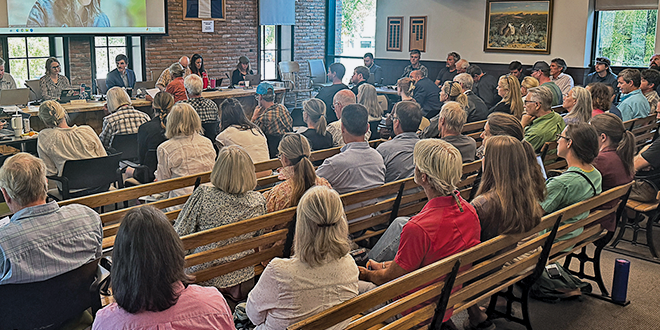
The Gunnison County Planning Commission held a joint public hearing with county commissioners last week to consider the Lower Verzuh major impact project application, and after more than five hours of public comments, applicant input and commission deliberation, the planning commission vote to recommend the project’s approval out of the sketch plan phase to county commissioners failed in a split 2-2 vote. Gunnison County Commissioners will review it on July 28. They may decide to hold another public hearing on the matter, or to approve or deny the application without further process, having already engaged in the public hearing with the planning commission last week.
The applicant, Bill Lacy and Daniel Dow of Lacy and Dow LLC, have proposed to subdivide a 450-acre parcel near Brush Creek Road along the east side of Highway 135, ultimately creating 433 housing units. The proposal includes 254 single-family, free market lots and 179 for-sale deed restricted units that would be designed and constructed by local developer High Mountain Concepts. Additional amenities would include connection to a future CB to CB South rec path, parks, ball fields and a transit stop and parking lot.
Lacy and Dow submitted the project application to Gunnison County in 2025, and after major adjustments in response to previous planning commission feedback, the planning commission reviewed the newest changes in May 2026. The public hearing on Thursday, July 9 drew more than 70 people speaking both in favor and in opposition of the proposal.
Planning commission members Eric Phillips, Brett Adkins and alternate members Anna Fenerty and Beverly Troxtell attended the meeting, with Sean Patrick and Karen Stock having recused themselves due to conflicting interests and Julie Baca absent. With just four members of the seven-member commission present, it came down to a split vote with Adkins and Troxtell voting in favor of recommending the project’s approval with conditions, and Phillips and Fenerty voting against.
After some initial uncertainty on how to proceed, Gunnison County community and economic development staff determined that according to the county bylaws, a split vote would not pass and there was no recommendation to county commissioners.
A divided public
The meeting began with a county staff review of the application followed by an applicant presentation of their proposal. Then dozens of attendees gave comments on the project, in addition to extensive public comments submitted to the county in written form. While many business owners and building industry professionals supported it, many neighbors did not. There was even one comment suggesting the applicant sell the property to the Crested Butte Land Trust, which was met with applause.
Jim Starr said, “The public has spoken,” referring to a petition with 650 signatures urging the county to deny the application (see pages 42-43).
Steven Moore cited a recent study that there are approximately 1,600 available lots approved for building in the North Valley already. “This is ag land and it has a large portion of senior water rights,” he said, and worried that the rights could be sold downstream and “leave us high and dry.”
Rob Dickinson spoke in support of the project, as a business owner with about 30 employees. He argued that if the meeting were held at 6 p.m., many others would show up in support. “But they are all working,” he said.
Reggie Masters applauded the workforce housing, but said she was concerned about traffic. “I’d like to see you table this, at least for a while,” she said, to allow things to settle with planned roundabout construction and other housing projects. “I don’t think it’s time, but it’s a beautiful proposal.”
Ashley Bembenick, on behalf of Coal Creek Watershed Coalition (CCWC) supported the project’s plan to tie into East River Sanitation District, and said the choice made here would affect the whole valley’s long-term water quality.
Andrew Arell said he appreciated the vision and ideas for the deed-restricted units, but questioned if this much housing is necessary at this moment. “Are we spurring population growth that may not actually be essential?” he asked.
Will Sawyer, electric contracting company owner, said more essential housing would help him recruit and retain apprentice electricians and help keep construction costs in the valley from increasing.
Ashley McLoud speaking on behalf of the Buckhorn Ranch subdivision, said they are concerned with water supply as well as the view corridor impacts and elk migration interference. She mentioned that Buckhorn is currently 40% built out.
Brian Murphy spoke in support of the application, saying he owns multiple homes for employees to keep them housed because they make more than the minimum standards for deed restricted housing and cannot afford free market homes.
Daryl Owen said he shares a fence and friendship with Bill Lacy, but opposed the project. “This valley has long been destined for development. It’s too beautiful not to,” he said. “But that development should be incremental…this development is far from incremental.”
Grant Bremer said the county borrowed money for a massive project (Whetstone), and he would like to see that county housing go to market. “At this time, I’m asking you guys to take a pause on this and see what gets absorbed,” he said.
Ivy Smith said she cleans the homes that the construction industry builds. “There’s nothing more depressing than dusting a home twice a month that nobody ever comes to,” she said. But she liked the affordable housing that the plan offers.
Devon Cone said she appreciated the developers’ thoughtfulness. She said she is a fan of dense housing, but not of this nature. “This seems more like suburban sprawl and I think most of us came here for something different,” she said.
Sue Navy said she has seen a great deal of infringement upon open spaces and wildlife habitat from development. “Rather than trying to funnel these animal herds through shrinking channels in subdivisions…let’s do some planning,” she suggested.
Teresa Sarnoff objected to deed restrictions with 3% annual growth in value, because 3% is inflation. “That is not real equity…you are in reality holding the property and renting and not participating in true ownership,” she said.
Brian Cooper supported the application, noting that the free-market homes in the plan are intended to be more attainable than others available in the North Valley, and said the petition represented less than 4% of constituents.
“Growth leads to more growth and growth leads to the need for more services and more taxes,” said Pat Wallace.
Tom Stumpf calculated the project would mean increasing the Crested Butte area population by more than 50%. “This is a rural area. We would ask you to keep it so,” he said.
Pat Magee, a wildlife biologist, said it’s great to live in a place that is so thoughtful and where people really care. He said biodiversity is about the life support system on the planet, and it’s eroding away as insect, bird and amphibian declines are a result of consistent habitat erosion. He argued the development would be a continued threat to those declining species around us.
A divided commission
The applicant responded to several public comments, and applicant attorney Marcus Lock emphasized that the developers want what many others want: clean water, clean air and preservation of the area’s lifestyle and agricultural heritage. He said many of the free-market lots, starting at one-quarter acres, were intended to be for those who don’t qualify for affordable housing but need a lower price point than is available elsewhere in the North Valley.
Lock concluded by asking that the planning commission give them the opportunity to move forward. He likened recommendation for approval to “saying maybe,” and allowing the applicant to do more work and continue the conversation for another 12 months.
County planning director Hillary Seminick reviewed that in the sketch plan phase, an application must either be found “substantially similar” to surrounding properties, or comply with applicable LUR standards and be found “compatible.”
The commission debated the density standards, and all members except Adkins found the density was not substantially similar to neighboring lots and neighborhoods.
Therefore the commission had to determine whether the application achieved all applicable LUR standards and would be compatible with existing land sets, as well as if expansion of the use would adversely affect future development of the area.
These standards include access to wastewater treatment infrastructure, transportation, protecting open space and clustering development appropriately. There was no debate that the access to wastewater infrastructure was present. The other elements were more challenging.
Adkins said he appreciated the applicant’s responsiveness to the commission’s feedback and generally found the project was compatible with existing uses and acceptable for recommendation.
Phillips said he too appreciated much of the applicant’s efforts but did not find the free-market density compatible with surrounding areas. “And if this was just about the affordable housing this would be a very different conversation,” he said.
Fenerty agreed that the density was not compatible with the surrounding areas and repeatedly stated she believed the application would adversely affect future development in the area.
Troxtell said she felt there was too much happening to properly assess those factors for the broader plan and landed in favor of recommending the project to enter preliminary plan stage for more discovery.
County commissioners weighed in to a lesser extent, as they were not the review body in this part of the process. County commissioner Liz Smith said she found the proposal one of the more thoughtful developments she has seen. She acknowledged that the application “seems to counter what we are hoping to see in the corridor plan, and yet we are using the LUR” in the absence of a corridor plan so it met the standards.
Ultimately, the motion to recommend approval with conditions was met with a split vote and failed; however, county commissioners will review the application for a final decision on July 28. County assistant manager for community and economic development April Kroner confirmed that commissioners can choose to hold another public hearing, or to forgo that and either approve, approve with conditions or deny it.
“As the motion failed by the planning commission, there is no recommendation from that body,” stated Kroner.