The Crested Butte News Serving the Gunnison Valley since 1999


Councilmembers want assurances to move forward
By Mark Reaman
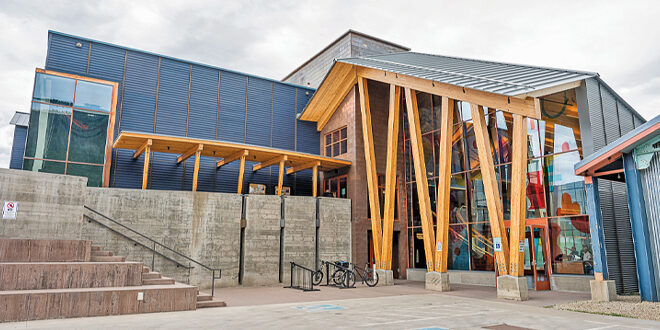
While town councilmembers expressed multiple issues and concerns over transferring ownership title of the new Crested Butte Center for the Arts building from the town to the nonprofit board of directors, the council remained open to the idea and discussions will continue.
Center executive director Jillian Liebl and chief business officer Brett Henderson have met with the council four times this year and explained that immediate and future fundraising would be much easier and more productive if the building was owned by the Center instead of the Town.
Currently the town owns both the Center buildings and the land. The Center leases the facilities for $1 per year under a 50-year lease with two 10-year extensions. There are 45 years left on the base lease. The Center is responsible for insurance, maintenance and utilities which currently amounts to about $300,000 per year. The Center paid for approximately 95% of construction costs for the $20+ million building through contributions from the community. Town contributed about $200,000 in cash and $800,000 worth of in-kind contributions during construction.
Henderson has said a donor has pledged to pay off the remaining $1 million in debt from construction of the new facility if ownership is transferred and he said going forward donors and potential financial entities would be more open to contributions and possible loans with the building under Center ownership.
“Our goal is to partner with the town to align on a facility ownership structure that preserves public benefit while enabling the Center to build a stable financial future,” Liebl and Henderson explained in a memo to the council at the July 21 council meeting.
The council spent about 40 minutes in a closed-door executive session receiving legal advice from the town attorney before having the public discussion.
“We are excited to continue the conversation about this opportunity in front of us,” added Henderson at the meeting.
Mayor Ian Billick asked to get a general sense of where the council was on the issue.
Billick asked if 1) anyone was ready to move forward as quickly as possible, 2) if anyone on the council was totally against the idea of ownership transfer, 3) if councilmembers were ready to proceed after working out specific details, or 4) if the council was open to keep talking and getting more information and more questions answered. The majority of the council said they fell into the fourth category.
“I support the Center as a nonprofit and am gaining trust given movement the Center has made,” said councilmember Anna Fenerty. “I’m in the fourth category and would love to continue discussing the idea but am still unsure of the numbers.”
“I am hesitant at the moment but could continue the conversation,” said councilmember Beth Goldstone.
“I’d like the Center to be in a place where you can succeed,” said councilmember John O’Neal. “I have some issues so I’m probably in the third category. My main concern is using the building to secure debt, and I would want all the current debt retired before closing.”
“I’m in the fourth bucket,” said councilmember Kent Cowherd. “Is it in the best interest of the town and the public to convey the building? I want to keep asking that question. But I too feel it is important to see you succeed.”
“I’ll put myself in the fourth category as well. I love what you’ve been doing and want you to succeed,” said councilmember Gabi Prochaska. “My hesitation is looking way down the road. The hesitation is in the long-term future, it’s not with you two. We need to protect the community.”
“The Center is an amazing asset, but I have continued questions,” added councilmember Mallika Magner.
Billick said he spanned all four categories. “I feel there is a way it could be done with minimal risk to the community. But it is being perceived in town by the public as a dangerous move and that is important. I’m leaning toward being comfortable transferring the title if the debt is paid off at closing and there is a fund or endowment for continued O&M (operations and maintenance) to handle it for some time. I don’t see allowing it to be used for a loan without the town signing off on that,” he said. “Town would also need a guarantee of community use going forward. It is critical for the Center for the Arts to succeed. The Center is one of the furthest local nonprofits when it comes to sophistication of fundraising and that’s important. But you need to do everything you can to have the community feel heard.”
Henderson said the comments were extremely helpful and when asked by Cowherd if the Center intended to use the building as collateral in a loan, he said it could happen under certain circumstances but that was not a priority. He said if during a construction project, say rebuilding the old Center building, the idea would be to have all the needed money raised for the project before starting it, but a loan could be utilized to act as a cash flow bridge with pledges over several years.
Cowherd asked if an even longer lease would help solve the issue and Henderson indicated it wouldn’t help with the lending market and some donors.
Fenerty said she would like to see a five-year financial and strategic plan before making a decision so as to see more evidence of continued stability.
“And from the community standpoint, I would need input from the community that there is support for this,” Fenerty emphasized. “I have only heard negative feedback on the idea or that people haven’t heard about it.”
Billick said the majority of the feedback he’s received had also been negative and it was important for the Center to engage the community and garner support.
“I agree that longer term financial stability is important for me to feel comfortable,” said Goldstone. “More information on reserves is needed.”
“That is almost a chicken and egg thing,” responded Henderson. “We would have more reserves if we weren’t using our money to pay off debt.”
Billick said he would want to see an O&M budget for the Center. He said the next meeting should provide ample time to be a longer, deeper discussion to begin driving toward a decision, whether it was to abandon the idea, move forward with the transfer or answer new questions.
Billick emphasized the Center should determine its red lines that would break a deal and make them clear to the council.
From the council perspective, Billick summarized that the council wanted the Center to see if the current debt could be retired before any transfer of ownership; investigate forming a solid endowment to reduce financial volatility; explain how and why the building might be used to secure debt and determine if the council could sign off on such action; guarantee community use of the facility in the future; provide a multi-year strategic and financial plan; provide ideas for use of the old building; provide ways to ensure future financial stability; provide an operations and maintenance budget; share a third party audit of the Center finances; and rally public support for the idea.
The next meeting on the issue should happen this fall.