The Crested Butte News Serving the Gunnison Valley since 1999


Difficult outlook for boating this summer
By Katherine Nettles
The historic low snow and precipitation year followed by unseasonably warm early spring weather has led to an early river runoff season, but recent weather patterns have made slight improvements on drought and soil conditions, according to local water experts. The only hope now is that monsoons will come in heavy to sustain minimum river flows and bring needed moisture to a drought-ridden river basin.
The Upper Gunnison River Water Conservancy District (UGRWCD) gave an update to Gunnison County commissioners this week which included sharing data on drought conditions, recent precipitation and water runoff.
UGRWCD senior water program manager Beverly Richards discussed the conditions of the valley’s water supply, showing that 98% of Gunnison County is now in drought, ranging from severe to exceptional. A majority of the county (57%) can be classified as in extreme drought. “But we have not seen any degradation in drought conditions since March 31, and that is due in part to the precipitation we’ve seen since the beginning of April,” said Richards.
April’s precipitation in the Upper Gunnison Basin has ranged from 0 to 200% of normal for this time of year ranging anywhere from one-hundredth of an inch to two inches. As Richards gave the update on Tuesday, there was more precipitation in the forecast, and hope to receive .5 to 2 inches across the whole basin over the next seven days.
Water year 2026 is trending closely with water year 2012 based on precipitation accumulation taken from eight Snowpack telemetry (SNOTEL) sites. In 2012, there were 12.3 inches at this time and currently there have been 13 inches of precipitation in 2026. “That puts us in the seventh percentile [of average] for precipitation,” Richards said.
“Unfortunately, snow water equivalent (SWE) for 2026 is not trending really closely with any years anymore, setting historical record lows,” Richards continued.
On April 24, SNOTEL sites showed that 1.3 inches of SWE remained in the basin, which is lower than any in recorded history. The Schofield location still registered some snow at that time; however all other SNOTEL locations had melted out.
Terrestrial water storage, which combines ground water, soil moisture, snowpack and surface water, has increased this month which Richards said is a significant improvement.
However, water tables showing current versus historic flow averages, particularly on the Gunnison River near Gunnison, are not lending optimism.
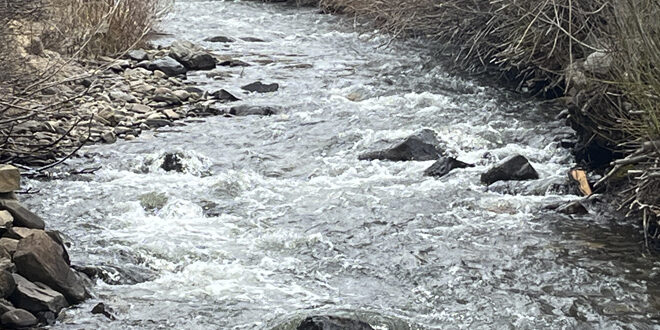
“I don’t typically report on stream flow this early in the year, but this is not a typical year,” said Richards. She described how in 2012, the peak flows at the Gunnison River occurred on June 5, at 632 cubic feet per second (cfs). A higher flow was recorded at that location on March 27 of this year, she said, and the reading there on April 24 was 219 cubic feet per second. The historic average is 823 cfs for this date.
“Due to extreme temperatures throughout the month of March, all sites have experienced an early peak which occurred on March 26 through April 1. Many water forecasters have said that this was possibly the peak flow amount for the year, and if that is the case it occurred nearly two months early.”
Reservoir storage for the entire Gunnison Basin is 75% of average, and the upper basin (Taylor and Blue Mesa combined) is 54% of average.
On a hopeful note, Richards did share that there are some indications of a monsoon season arriving this year. “When it will occur and how strong it will be is still in question,” she said. But to rebound from the damage already incurred this year, “it would take disastrous flooding events in order to reach that point. We don’t want that either,” she concluded.
UGRWCD manager Sonja Chavez reviewed that there have not been water calls on Blue Mesa this year due to low levels. “We’ll see what next year looks like and what our monsoon season looks like and if it allows us to recover a little bit before we go into the fall,” she said.
Chavez said there is potential for calls on Taylor Reservoir. “We had releases down to 60 cfs, and we were trying to hold on at that amount hoping we would see some additional contribution coming in from the streams to Taylor below the reservoir. And that just never materialized,” she said.
The district had to bump up flows to 150 cfs last week to avoid a call on the Upper Gunnison River below Almont. Chavez said she hoped it would keep flows going a little while longer with the addition of new precipitation.
She cautioned the conditions are fairly “dire.”
“I think this year is going to be a very difficult year for the commercial boating and rafting community. If we can hold on a little longer, if we can get those monsoons, we hope to give them a 30 to 45 day season. If we can’t and hydrology continues to tank there may not be a season at all,” said Chavez. She noted that the Taylor Users Group met last week.
“Everyone seems to be working really well together and just understanding how extreme this year is going to be,” she said.