The Crested Butte News Serving the Gunnison Valley since 1999

Raising awareness for nonprofit We See Hope
By Dawne Belloise
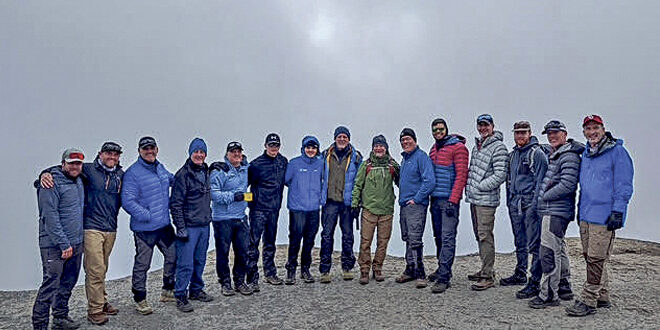
What began as an idea to support young people in sub-Saharan Africa took seven local climbers from the Gunnison Valley to the summit of Mount Kilimanjaro. The plan was initiated by Tom Miller, who enlisted friends to climb Mount Kilimanjaro in support of We See Hope, an international non-profit that has spent the past 25 years working alongside communities across sub-Saharan Africa.
The idea was to raise one dollar for every vertical foot gained of the 19,340-foot climb. The project became known as Climbing for Change: We See Hope. The local climbers included Jeff Jones, Nik Wogan, Carl Tucker, Curt Linville, Ted Crofford and Jim Consedine. All are full or part-time residents of the Gunnison Valley.
The team departed for Africa on January 10 and Miller left earlier than the others to visit some of the villages that will benefit from the funds, “and to see the projects that are just beginning or have been in place for a year or two,” he said. He visited three different villages, each at various stages of We See Hope’s support efforts. Miller described the experience as deeply affirming. “It was really encouraging. The work matters, it makes a difference with measurable outcomes.”
We See Hope focuses on children who are vulnerable to exploitation and lack of opportunity, by providing access to community-led education, child rights programs and economic empowerment. Developed in partnership with a network of local NGOs, the programs teach children skills to change their own futures while supporting families and entire communities. Now in its 25th year, We See Hope has reached more than 728,000 children to date. The need is immense with an estimated 553 million people in sub-Saharan Africa living in multidimensional poverty, with nearly half of them children. More than 83% live in rural areas, where access to schools, healthcare and basic infrastructure is limited. Over 317 million children under the age of 18 are affected.
Miller described We See Hope’s integrated approach as transformative. Young people are mentored, supervised and taught skills that allow them to stay in school and contribute to their communities. “If the kid stays in school, he stays around to help the community,” he says. Training programs include trades such as seamstress, carpenter and mechanic, which are all pathways that keep young people off the streets, keep them in their community and create sustainable futures. “It’s the coolest culture,” Miller says of the people and their ways in these villages. “It’s kind and gentle. The focus is on the young kids, the impact on the adults is huge.”
The climbing team began their trek on January 15 via the Lemosho Route, which passes through five distinct climate zones from tropical forest to alpine desert. “Our community here comes together to support a cause,” Miller says, “and it creates bonds that are deeper and stronger, and enables trust, joy and living a life that matters.”
Fifteen climbers participated in total, raising $220,000 to date. Everyone paid their own way, ensuring that all proceeds went directly to We See Hope.
The climb itself was demanding but the challenge was manageable, Miller says of the five days of trekking that felt similar to hikes in the Gunnison Valley. Base camp was around 15,000 feet. The summit climb began at midnight, with 4,000 vertical feet over 3.5 miles in bone-chilling cold. “It was really, really cold,” Miller says. Jeff Jones agreed, and during the trek claimed that it was the coldest he’s ever been in all his mountain climbing, “including Colorado’s fourteeners.”
At the summit, exhaustion gave way to awe, says Miller. “You get to the top and the sun rises, and it’s pink and purple stripes as the sun rises. We’re above the clouds and it’s the rim of a volcano. You can see the arc of the globe.”
Due to altitude and safety concerns, the group stayed only about 30 minutes before descending, which Miller says proved to be the hardest part. “We’re dropping nearly 14,000 feet in about 28 hours. You’re eight hours on your feet going down,” Miller said. “It’s hard on your knees and quads. It’s hard.” Throughout the trek, the team was supported by six Tanzanian guides and approximately 60 local porters, all highly trained. There were that many porters because porters are limited to carrying 40 pounds and are trained through programs that can lead to professional guiding careers. “We had a high level of respect for those porters,” Miller says.
After the descent, the team spent a night at a hotel in Aishi Machame before beginning the long journey home. They arrived back in the valley on January 24, delayed by weather and rerouted through Durango due to a storm, and having to drive the sketchy Red Mountain Pass. The trip home took nearly 40 hours door to door. Then there was the jet lag but Miller smiles and says that although he was exhausted, he’s grateful and inspired, having returned home knowing they had helped support a lasting change, deeper connection and a cause that truly matters.