 The Crested Butte News Serving the Gunnison Valley since 1999


Budget $280K in the hole next year
by Mark Reaman
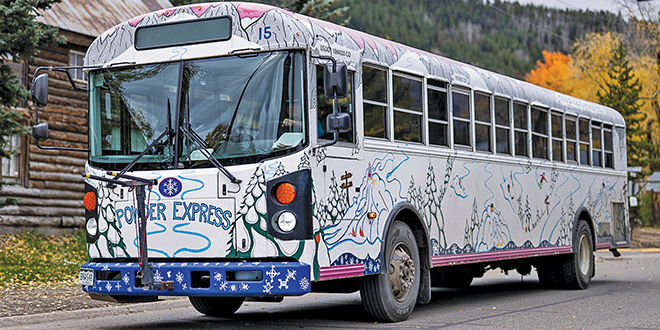
The Mountain Express is facing a budgetary cash crunch for 2027 and ideas being discussed to fix that dilemma include making drastic cuts to regular bus service. The issue resulted in an hour and a half discussion at the October 6 Mt. Crested Butte town council meeting that did not result in any recommendations but sounded the alarm loud and clear.
Mountain Express managing director Jeremy Herzog gave his report to the council focused on two big issues — the decline in numbers with FirstTracks ridership in the summer, and a $282,000 budget deficit for next year. That deficit amounts to about 7% of the $4,236,436 proposed budget. Given the budget situation, the transit agency is looking at among other things, eliminating the extra winter town shuttle weekend service during peak morning and afternoon hours; eliminating spring and fall service; shrinking summer service frequency between CB and Mt. CB to 40 minutes; losing the holiday “elf bus”; eliminating Mountain Express ambassadors; and nixing employee professional development.
Starting with summer, Herzog presented figures showing FirstTracks, which serves north Mt. Crested Butte in a sort of Uber scenario, carried 4,324 passengers this summer compared to 6,098 passengers last summer. That amounts to about $23.82 per summer passenger. Mountain Express pays Via Transportation, the owner of FirstTracks, $103,000 to operate for 12 summer weeks. Overall, Mountain Express carries about 120,000 passengers in the summer compared to approximately 480,000 in the winter. FirstTracks last winter carried 52,562 passengers and charged Mountain Express $480,746.
Herzog pointed out that the Mt. Crested Butte rebate program for e-bikes has been successful and is probably having an impact on summer bus ridership along with the fact that people drive more when doing activities like paddleboarding or even getting to mountain bike trailheads.
“I have a real worry about next summer when the Elevation Hotel is closed for renovations,” Herzog said. “I’m worried our pretty unactivated base area is going to get even more unactivated. I think continuing the program without that facility up and running next summer will result in a continued decline in ridership.”
Council held a long general discussion on operations and asked Herzog to provide more specific information about peak times and ridership in the summer, and he said he would report back to the council.
As for the $282,000 budget deficit, Herzog reported the bus system had capital reserves set at $1.5 million “which is enough for our contribution to the bus barn facility at Whetstone and $400,000 worth of new buses in the next three years. Operating reserves are set at $1.4 million and that was done after the fiscal audit completed in June.”
The bus barn facility is estimated to cost $18 million and Herzog explained that with federal, state and local contributions, the cash is there to do the project without going into debt.
“So, with these numbers, you could dip into the operation fund and not cut services this year, right?” asked councilmember Steve Morris.
“Yes. That is an option,” responded Herzog. “But I would say the board would not support that option based on the last conversation. I was given the target to come back with a budget that had roughly a $70,000 deficit at most. So, we need to roughly find another $200,000.”
Like most other area government entities, Mountain Express is budgeting that sales tax revenues will be flat in 2027 but costs like wages, insurance, expanded winter First Tracks service at peak times, and gas, will go up. More than 92% of the budget is dedicated to wages.
Herzog said his objective for the suggested budget cuts was to 1) reduce operating costs to align with expected revenues, 2) maintain the most efficient and effective routes that benefit patrons, 3) maintain working opportunities that can realistically staff and retain employees.
“One thing I’m hung up on are the schedule adjustments suggested,” said Morris. “We have learned from the RTA that consistency and frequency are the two things that matter the most in maintaining and growing ridership. When you disrupt those, you lose ridership at significant rates.”
“The question is how often and how deep do you want to go into the reserves,” said councilmember and Mountain Express board chair Roman Kolodziej.
“These suggested service cuts will be a hard sell to the community when everybody knows we just got a massive $14 million grant for the bus barn and the bus barn is there to service the buses — but it is challenging if the buses aren’t running and aren’t doing the job in the first place,” said councilmember and Mountain Express board member Valeda Scribner.
Herzog said summer service has been shrunk as much as possible, “in terms of getting seasonal employees to come back. Cutting back summer any more than the 15 weeks it currently operates is not going to be operationally effective either.”
He noted that losing key employees in summer could carry over into winter and that would catastrophic. “But I’ve been given direction to come up with cuts,” he said. “Any decision could have unintended consequences.”
A spending or a funding
problem?
Council spent a lot of time throwing out other potential alternatives such as cutting back or eliminating the Castle/Crystal Road condo loops, and having the town shuttle turn into Pitchfork from Gothic Road. Herzog said those ideas did not make financial or logistical sense.
“I don’t like these options,” mayor Nicholas Kempin stated. “Are there not others?”
“I would ask what happens next year when we are in the exact same scenario with fewer reserves,” said Kolodziej. “In three years, there will be no other option.”
“It sounds like to me it’s not being funded to the level it needs in order to maintain consistent service throughout the year,” said Scribner.
“I 100% agree with you,” said Kolodziej.
“So, let’s figure out how to fund it. That seems like the issue instead of just cutting,” suggested Scribner.
Kolodziej said one factor in “softening” a cutback or elimination of off-season service is that the RTA provides service between CB and Mt. CB during that time. “Maybe they can make more stops,” he suggested. “At least we can start having these exploratory conversations.”
Kempin, who sits on the RTA board, said adding time and more stops to the current routes would not be an easy ask.
“The big picture is still the goal to serve the community,” said Scribner.
“The other option is for the fellow towns to put more money toward the bus service and accept some level of cutbacks and dip into the reserves,” said Kolodziej.
“Could we redirect some of the money going to the Late Nigh Taxi?” asked Kempin.
“What about asking Vail Resorts (CBMR) for financial help? Or the DDA? What are other funding avenues?” asked Scribner.
“Cutting the extra winter shuttle bus peak service will definitely result in longer lines and longer wait times and impact the customer experience,” said Herzog. “That might matter to CBMR. We plan to approach them and explain that.”
“I’d definitely be more interested in pursuing a scenario where both towns potentially do more before we take such drastic cuts,” said councilmember Alec Lindeman.
“If we want more money from Vail, we can raise the admission tax,” suggested councilmember Bruce Nation. “We don’t have to ask them for it. We have to ask our citizens, but not Vail.”
“It sounds like an ask to Vail is first in order,” suggested Kempin. “It doesn’t hurt to ask.”
Herzog said he would gather more facts and figures for the council to mull over. He plans to make a similar presentation to the Crested Butte town council at its October 19 council meeting. Ultimately, it is up to the Mountain Express board of directors to decide on any action.
That board will discuss the situation at its Thursday, October 22 meeting that will be held in the Crested Butte town council chambers starting at 9 a.m. Public feedback is being sought before or during the meeting.