The Crested Butte News Serving the Gunnison Valley since 1999


Moving into preliminary plan after split vote
by Katherine Nettles
Gunnison County commissioners debated for more than three hours on Tuesday before approving the Lower Verzuh major impact sketch plan application with conditions. Commissioner Laura Puckett Daniels voted against the approval, while commissioners Liz Smith and Jonathan Houck voted in favor. The three discussed an extensive list of conditions for the approval prior to the vote, however due to time constraints they directed staff to fine tune those conditions into a final draft and come back to the commissioners later to approve them separately.
With the approval, the applicants, Bill Lacy and Daniel Dow, can now move to preliminary plan with their proposal to subdivide a 450-acre parcel of land near Brush Creek along the east side of Highway 135. Preliminary plan allows one year for the applicants to meet numerous, more specific requirements within the county’s Land Use Resolution (LUR).
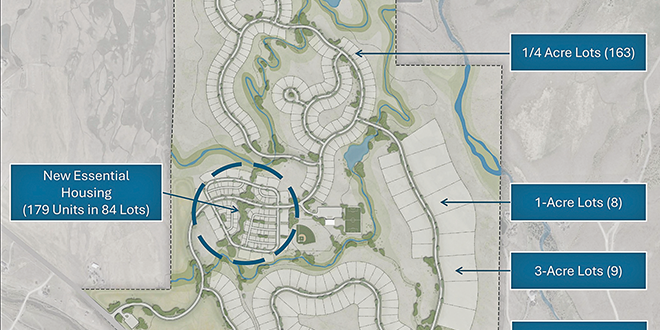
The plan calls for 240 free-market lots, ranging from one quarter acre to three acres, and for 179 deed-restricted for-sale units to be designed and built by local contractor High Mountain Concepts.
The debate about whether the project met sketch plan LUR standards was at times heated between commissioners as Puckett Daniels, a former chair of the county planning commission, argued that the plan did not meet the standards in several fundamental ways while Houck and Smith argued that they did.
The first major hurdle in the discussion came at the same first sticking point that the planning commission had found: whether the proposal could be considered “substantially similar” to surrounding properties. Houck believed that it was, especially considering the similar density of the nearby Buckhorn Ranch subdivision. Puckett Daniels expressed strong opposition to that, noting Buckhorn’s relatively small portion of the surrounding area and the other, mostly larger parcels and sparser density surrounding the property.
Smith did not seem as convinced that it was similar, and Houck agreed to look at the next requirement that if a parcel is not substantially similar, it must be compatible.
That requirement had several subsequent criteria. Again, Puckett Daniels found that the proposal did not meet the standard. She found the application incompatible with the character of neighboring areas and uses, ranging from wildlife uses, clustering and housing density to having adverse impacts on future development. She openly questioned, “Are the 179 deed restricted homes worth it? At this juncture we need to be convinced that it is yes. And I am not convinced that this does not have cumulative, negative impacts,” she said. She acknowledged that “I could absolutely say yes to something here…but the scale at this time with the accumulation of impacts, the lack of clustering…I’m not sold.”
Houck noted that preliminary plan would likely bring many changes to the parcel based on water, wildlife, transit and transportation studies. He was more in favor of letting the process run its course to learn more than denying it at the first stage. He and Smith both found the essential housing the applicant included to be a major factor in consideration of approval.
“I think you and I are having a lot of parallel talks around this, but this is where we separate,” said Houck. He quoted LUR section 7-103, “Sketch plan is exploratory; preliminary plan finds detailed solutions.”
“I hope you say that to yourself in your sleep tonight,” quipped Puckett Daniels.
“There are still massively high bars to clear for this to be approved for me [at preliminary plan],” continued Houck. “I think the idea of how they are structuring the finance piece to support the workforce housing is innovative and compelling. But at some point, you’re going to have to provide some proforma…”
Houck also made the case that the quarter-acre free-market lots were likely to be attainable for some of the valley’s “missing middle” families to build homes.
“I don’t think so,” responded Puckett Daniels. She and Houck then debated current building costs.
Houck remained firm that while he shared many of Puckett Daniels‘ concerns, “I want them to vigorously explore and prove to us, through preliminary plan, that they can make this work.” He emphasized that if the applicant did not, and the preliminary plan was denied, any costs incurred by the applicant to that point was their own burden to bear.
Smith said she believes the free market homes, even if out of reach for most valley residents, would be an acceptable tradeoff for the affordable housing they would build and sell to locals. “I think it is remarkable that the applicants think that they can pair 40%-plus of essential housing with these other homes,” she said. Smith shared her own concerns about clustering and wildlife impacts but suggested they include them in approval conditions. “If we don’t have thoughtful proposals that are building in [essential] housing for purchase…we’ll see that effort put toward other projects that are not serving any of these things that we are wanting to address.”
Houck added that he would feel more skeptical if it were not High Mountain Concepts sitting at the table, with vast experience with county codes and housing.
Puckett Daniels agreed that their work in the community lends credibility to the application and applauded their innovation. But she then addressed the impacts Colorado Parks and Wildlife named that would come from the large-scale development. This included traffic, population increases and demands on infrastructure, water use and services.
Houck said he agreed, as did Smith. They debated the tradeoffs again.
“I do wonder if just 13 houses are better,” said Puckett Daniels.
“Maybe we could better preserve our rural character if it’s just the ultra-wealthy that get to build houses on the north end of the valley, and we’re just closing the gate on people who are trying to live and work in the same area,” rebutted Smith. She noted this wasn’t an accusation but a conundrum. “There’s not an obvious decision there,” she said, noting her frustration with the LUR’s lack of “more refined tools to actually measure” thresholds and impacts for development.
Puckett Daniels ultimately suggested they take a vote, as she did not get the sense she was going to convince her fellow commissioners to deny the application. They built off the planning commission’s recommended approval conditions and added more of their own but eventually decided to allow staff more time to complete the final draft.
Smith made a motion to approve the application and direct staff to provide a resolution with the conditions discussed. She and Houck voted in favor of it, while Puckett Daniels voted against.
All expressed that they appreciated the conversation they had engaged in, and acknowledged the imperfections of applications, the limited tools of government and the challenges of balancing community needs with the means to support them. Puckett Daniels also said she wanted to honor the community which articulated “really clear values” about the community character and values, “whether for or against this project.”
She again stated her reasons for finding it did not meet the LUR standards. “But I am grateful to everyone who has participated in this process, the thoughtful deliberation of this board, the careful participation of the planning commission and the staff and the legal team, and the applicant.”