The Crested Butte News Serving the Gunnison Valley since 1999

by Dawne Belloise
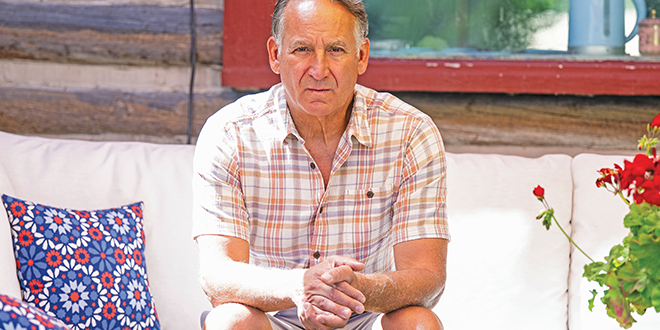
The odds were, David Gross shouldn’t even be alive. The ‘widow-maker’ he suffered in the backcountry would have taken the life of about 90% of those who suffer that type of heart attack, even if they’re close to a hospital. But David was one lucky dude, even though he was far from medical attention, hiking and running the 11 miles of the West Maroon Bells trail back from Aspen to Crested Butte earlier this summer with his longtime running partner Milo Wynne. They were about five-and-a-half miles from the trailhead and about a mile from the Maroon Pass summit when David started having overwhelming chest pains. The experience has redefined his life.
During his 40s in CB, he was a competitive endurance athlete. He did the winter Grand Traverse 10 times and ran the summer one twice. During that decade, he was also a triathlete, completing six grueling Ironman triathlons. He first discovered an irregularity in his heart rate and went to a cardiologist 10 years ago. The doctor told him he had a left branch bundle block, where the electrical impulses traveling to the left side of the heart are delayed or blocked. He now realizes, “With hereditary heart disease, I made a big mistake by not going on statin.”
He figured as an uber athlete he could change his family history of heart problems, “but that was not the case,” he discovered. He didn’t go on the meds and when heart issues took beloved locals Don Cook and Frank Magri, “All these seemingly athlete guys passed away so I went to get a calcium score last January and it was off the charts.” David then went to see a local cardiologist and did a stress test and a nuclear test, neither showing any problems. He was cleared to exercise. “No one seemed too concerned,” he says, so he eased back into light exercising about four days a week.
The opportunity came up to go with Milo to deliver a shuttle for hikers on the Aspen side and then run back. “It’s something I’ve done 50 times before in the last 20 years.” Despite the cleared for exercise prognosis, the widow-maker hit anyway. “I had been told not to do anything extreme, but I felt that trail wasn’t extreme,” he says. David’s attack was caused by plaque that broke up inside his arteries and then formed a blood clot. In an extremely fortunate and serendipitous occurrence, an orthopedic surgeon from the Steadman Clinic ran by in the first minute he was having chest pain and on the ground. They had aspirin and David feels that may have initially saved his life. From there, Milo ran to others on the trail who had a satellite phone and called Search and Rescue. “It took them a while since they had to drive up the valley and then hike in.” About four-and-a-half hours later, he was flown out by army helicopter to the fire department and then transferred in an ambulance to Valley View Hospital in Glenwood Springs. After deciding he didn’t need open heart surgery, they inserted a couple of stents.
It was seven hours later, and he had flatlined during that time. David saw images, “Silhouettes of my two kids when they were young, and I was at peace. I’ve broken multiple bones over the years, been in construction accidents, played lacrosse and had all kinds of injuries, but the pain threshold of this heart attack was overwhelming.” Besides taking a physical toll, David has had to unravel the event mentally and emotionally. “This whole experience says I shouldn’t be alive and chances of survival were pretty much nil. I shouldn’t really be here, especially not after seven hours. Mentally I’ve been unpacking it all.” He’s seeing a mental health professional to help him deal with the trauma.
“Spiritually, during the whole episode I was at a point where I had accepted death and I wasn’t scared. I didn’t have anything negative coming into my head while I was drifting in and out of consciousness. I’m now thinking about what I want to do with the rest of my life and how I want to live it.”
Recently, an important milestone also changed his life. “I got sober a couple of years ago and that’s been huge. I have an incredible team of people working for and with me. I have eight construction projects, and mostly I’ve been working behind the scenes,” he says of his construction company. “It’s run smoothly,” he says, even though he’s been in the back seat. “I’m not sure when I can return to work full-time. I’ve been a builder for 33 years, 20 of those here and 13 in Philadelphia.” He’s started cardiac rehab with Boone Heart Institute in Greenwood Village, in Denver.
David was born and raised in a suburb outside of Philadelphia. He tells that his childhood was somewhat feral but not completely. “It was an affluent suburb. We did a lot of chores when we weren’t playing sports. I played a lot of sports in middle school and all through high school,” until he graduated in 1987. He played football and lacrosse, and at Michigan State University where he attended college, he played Division 1. “I wanted to go to a big school and play lacrosse and party,” he laughs.
David had been a roofing laborer in high school so his first summer back from college he started working construction, and it carried him through his summer college days. He signed up for classes in Building Construction Management, but with lacrosse and extra curriculum activities, he was not able to complete that degree and instead earned a BA in psychology in 1992. After graduation, David got a job as a headhunter in Chicago, and he laughs, “I have no idea how I got that job,” but he did that for two years. “A bunch of my friends also moved to Chicago, and we had a riot there.” Then his dad offered him a job with his wholesale distribution company that supplied nonperishable items and sundries to places like grocery chains. David worked in sales and ended up managing all the sales reps in 30 states and traveling all the time. He and his dad started buying old brownstone buildings in Philadelphia and converting them into flats. “I loved construction and loved building things. I couldn’t fix a car, but I could build pretty much anything.”
In 2003 David came to CB on a ski trip with his then wife Sue Gross. He met Don Pulley who showed him land in Trappers Crossing, which he ended up buying in 2004. He then returned on vacation in the summer of 2005, with his wife, one-year-old son, Ben, and his brother’s family. “Somehow, I convinced my wife to move out here and I went to work for Fran Guy as a subcontractor supervisor in 2006. I loved living here.”
David claims he was overweight and not very healthy when he arrived. He met Rob Maheady who got him into backcountry skiing in 2007. “We did the Grand Traverse six times together. Then I got into trail running, triathlon and worked like a dog for years. My east coast work ethic kicked in which wasn’t really the CB lifestyle. I let my ambition get the better of me. But it’s also been really good to me, the whole CB thing has been amazing.”
He and Sue went their separate ways four years ago. Their son, who was born in 2004, needed to be in a metro city that had medical resources and support for children with Downs Syndrome and Autism. “He’s doing great in the Philly area,” he smiles. His daughter Jayne was born in CB in 2008 and is working a summer job in town at Tin Cup Ice Cream. She lives with her mom in the Philadelphia area.
Although David considers CB his home, he tells, “I do spend a lot of time in the Bahamas. I have a small house there that hopefully I can spend my winters there. I grew up saltwater fishing on the Jersey Shore,” he recalls of his childhood summers. His grandfather and father taught him to fish and his parents, now in their 80s, zip around in the Bahamas.
But David feels connected here, “I have a handful of really good friends. In Crested Butte, you have to be a decent human being just to stay here. It’s one of those places where you’re either a good person or you’re not and if not, you don’t last here.” The outpouring of support during his heart attack incident showed what kind of community our town is. “I want to continue to be able to build. I’ve been blessed with great clients. I’ve worked really hard but I’ve also been lucky. I’m just grateful to be alive and for a second chance. If it weren’t for Milo, and a higher power that saved me, I wouldn’t be here,” he says. “Because it wasn’t all just luck.”