The Crested Butte News Serving the Gunnison Valley since 1999

“The optimism is back to keep this tradition”
By Than Acuff
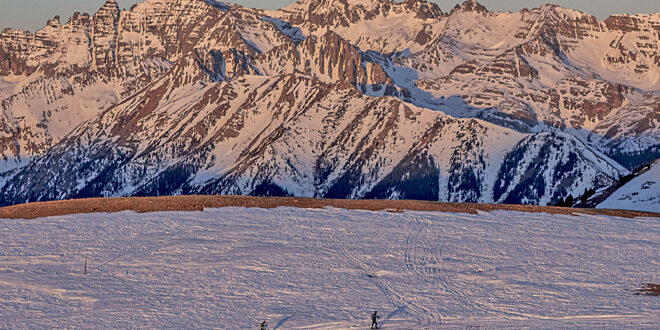
It was touch and go there for a hot minute, hot couple of days actually, hot couple of weeks really, but as the start of the 28th evil eye Grand Traverse drew near, the field teams remained diligent in their efforts monitoring the weather, snowpack and course conditions. In addition, teams doubled down their efforts packing down the track and shoveling snow on sections of the course and Mother Nature honored their efforts with colder temperatures to provide an opportunity to send 143 teams of two skiers each from Crested Butte at Midnight Saturday bound for Aspen on Sunday, March 29.
And when all was said and done 113 teams finished, the final team crossing after spending 18 hours and 30 minutes on course, with the Crested Butte duo of Cam Smith and Logan Greydanus winning the overall title. The father/daughter Gunnison duo of Jesse and Bria Rickert won the coed title coming in fourth place overall and Crested Butte ski patroller and CBAC intern Brie Yost teamed up with fellow Crested Butte ski patroller Bari Beasley to take the women’s title, finishing in 11th place overall.
The fact that it went through this year is nothing short of a miracle given the weather. But the snow safety team was on it and when it came down to it, they liked what they saw. And not just with the snowpack but with a variety of other factors including but not limited to the ascent to Star Pass.
“It was a process,” says Grand Traverse snow safety director Jake Beren. “On Tuesday when we headed into the Friend’s Hut, we were relatively sure the race wasn’t going through. But as the week continued, we started losing reasons to cancel the race.”
With the snowpack cooperating, Beren and his team at the Friend’s Hut as well as Ben Breslauer and the team at the Opa’s Hut had additional issues to consider.
The typical route to Pim’s Point to get up and over Star Pass was a frozen surface offering slide-for-life conditions that Beren and his team felt would be problematic for racers.
“We needed ski crampons to get up there,” says Beren.
So, they adjusted the route accordingly. Meanwhile, Breslauer and his team were busy setting track for the racers and for any evacuation.
“They did some impressive snowmobile work to make sure they could get people out if needed,” says Beren.
With a frozen surface, the snowpack cooperating and all things in place, the green light to go to Aspen was given.
“The avalanche piece was almost the easier one to make,” says Beren. “By the time we got to Friday night and Saturday morning, we were feeling good and had the evidence to back it. It was a fun set of problems to work through and hats off to the racers for deciding that’s what they wanted to do.”
And after the race was cancelled last year and reversed the year before, it was great news for Crested Butte Nordic, and the teams.
“Huge relief, and a bit of disbelief,” says Crested Butte Nordic executive director Hedda Peterson. “I was just so excited for the racers and for the field teams because we all want to see it go through.”
And just like every Grand Traverse race before, this one was different. Maybe even more different than all the rest as the low snow year forced teams to run on dirt the first 12 miles, including wading through three creeks, before getting on snow.
“It was weirder than all of them,” says Smith, who now has seven races and five titles to his name. “It wasn’t super hard from an effort standpoint for us. It was just super mentally engaging and challenging. There was a never-ending stream of obstacles.”
Given it was a running start, Smith and Greydanus opted to remain conservative through the initial portion allowing a handful of teams to charge out front yet still keep them in reach. The difference came once the race turned to snow. While some of the lead teams opted to wait until after the third creek crossing to switch to ski gear, Smith and Greydanus switched over after the second creek crossing and then moved into the front at the third creek as other teams switched to ski gear.
From that point on they stayed out front with only one hiccup as Smith followed a track to Taylor Pass only to realize he was on the wrong route while his teammate remained on the correct route.
“Because the surface was frozen, it was really loud and I couldn’t hear Logan yelling to me,” says Smith.
He soon realized his mistake, changed course and they headed over Taylor Pass, over Gold Hill and along Richmond Ridge to the top of Aspen Mountain on a track that still had dirt sections, or a refrozen and variable thin strip of snow to navigate, before bombing down to the finish line at the Gondola Plaza at the base covering the near 38-mile course with close to 7,000 feet of climbing in just under seven hours, 23 minutes and 53 seconds.
Two more men’s teams crossed before the Rickerts came through covering the course in a time of nine hours, 16 minutes and 23 seconds. Five more men’s teams and one coed team then crossed before Yost and Beasley came through the finish line arch in a time of 10 hours, 27 minutes and 41 seconds for the women’s team title, much to their surprise.
“We really had no concept of where we were in the pack,” says Yost. “We expected we needed to break 10 hours to win.”
It was a bit of revenge for the two skiers as well. After having their first race in 2023 turned around for a reverse and their second attempt last year cancelled, they finally got to ski, and run, the entire race.
“We went for redemption this year,” says Yost.
And for all intents and purposes, their race seemed fairly smooth as well, though Yost admits she’s not much of a runner and there was some pain, and offered what the race always offers.
“The only run I’ve been on this season was for the 8-Ball Rally,” says Yost, which she won as well. “But Bari runs so she kept it light like we were just out for a jog. Richmond Ridge was tough. My shoulders and hip flexors were hurting. There were a lot of sections where we were out by ourselves. It felt kind of surreal.”
Yost echoes Smith’s sentiment about the nuances of the race that kept them on their toes nearly the entire time.
“It was engaging the whole time,” says Yost. “All of the descents were very harrowing, but it was fun, like an obstacle course.”
As for the future of the race, the energy appears to be in place to keep this tradition that started almost 30 years ago going.
“Every year is a monumental effort, and this one took so much more,” says Peterson. “The field teams and volunteers did so much work and we heard so much excitement from so many finishers saying they can’t wait to be back next year. Long live the GT.”
Smith believes that the fact that this one went through has reignited the Grand Traverse fire.
“There we all were again,” says Smith. “Sitting in lawn chairs in Aspen, swapping stories and watching more teams coming in. It was fun to see it back to normal. It’s inspiring to see hundreds of people make the traverse and the field teams making it all happen. It’s inspiring to be a part of. The optimism is back to keep this tradition.”